If you’ve received “IDTS” in a text, social media comment, or online chat, you may have wondered what it means. Like many internet abbreviations, IDTS helps people communicate quickly without typing a full sentence. While the acronym is short, its meaning can vary slightly depending on the conversation, tone, and platform.
In this guide, you’ll learn the IDTS meaning in text, where it came from, why it’s popular, how it’s used across social media, and how to interpret it correctly in different situations.
What Does IDTS Mean in Text?
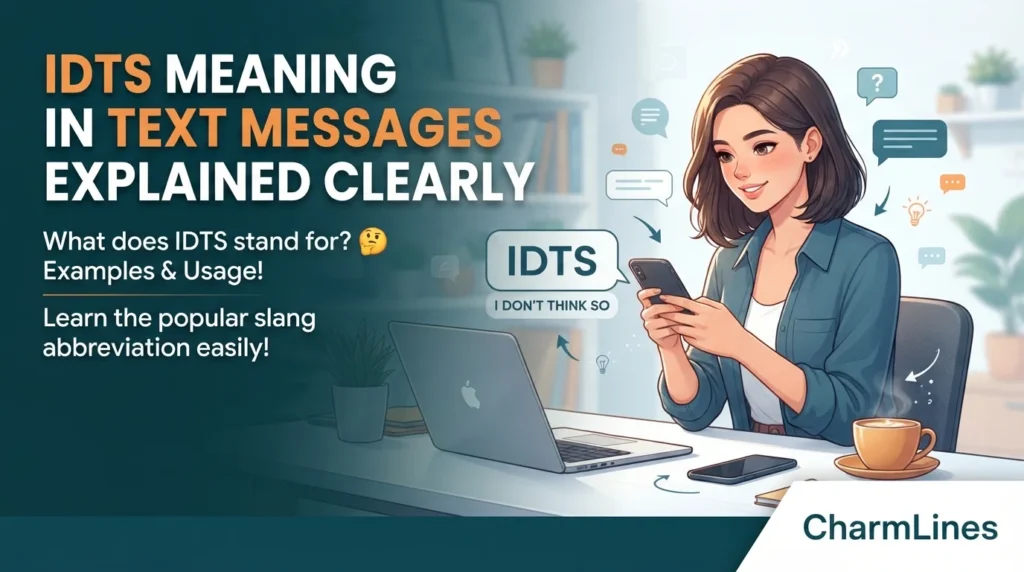
IDTS stands for “I Don’t Think So.”
It is an informal internet abbreviation people use to express:
- Doubt
- Disagreement
- Uncertainty
- A polite refusal
- Skepticism
Instead of typing the complete phrase, users simply write IDTS to save time in conversations. The abbreviation has been widely documented in online slang dictionaries and texting guides for years.
Simple examples
Example 1
Alex: Are you coming tonight?
Sam: IDTS.
Meaning: I don’t think so.
Example 2
Taylor: Do you think it’ll rain?
Jordan: IDTS.
Meaning: I don’t think it will.
Primary Search Intent
The primary search intent behind “IDTS meaning in text” is informational. Most users simply want to understand what someone meant when they received the abbreviation in a text, DM, or comment.
Secondary search intents
People also want to know:
- Whether IDTS is rude
- How to reply to IDTS
- Where it’s commonly used
- Whether it has multiple meanings
- Platform-specific usage
- Similar texting abbreviations
What Does IDTS Express?
Although the literal meaning is always “I Don’t Think So,” the emotional tone depends on context.
1. Polite disagreement
Someone disagrees without sounding harsh.
Example
“I think that movie was amazing.”
“IDTS.”
2. Uncertainty
The speaker isn’t completely sure.
“Will they arrive early?”
“IDTS.”
3. Gentle rejection
Someone declines an invitation politely.
“Wanna grab lunch?”
“IDTS, maybe tomorrow.”
4. Light sarcasm
Sometimes IDTS is used jokingly.
“I’m definitely winning this game.”
“IDTS 😂”
Dictionary.com also notes that the abbreviation can be used sarcastically depending on context.
Why Did IDTS Become Popular?
IDTS became popular for the same reason many texting abbreviations did:
- Faster typing
- Mobile texting convenience
- Character-saving during early SMS and social media
- Casual online communication
- Easy expression of disagreement without sounding overly direct
Its widespread use dates back to the era of SMS messaging, instant messaging, and early internet chatrooms, where short acronyms became common.
Origin of IDTS
Unlike many slang words that originate from a specific online community, IDTS evolved naturally as part of internet shorthand.
It follows the same pattern as abbreviations like:
- IDK
- IMO
- TBH
- BRB
- SMH
- NVM
The abbreviation gained popularity through texting, online messaging, gaming chats, and social media before becoming part of everyday digital communication.
How IDTS Is Used Online
Most people use IDTS as a quick response instead of typing an entire sentence.
Examples include:
- “IDTS that’s true.”
- “IDTS she’ll come.”
- “IDTS it’s worth buying.”
- “IDTS lol.”
- “IDTS but maybe.”
The surrounding conversation determines whether it sounds uncertain, humorous, skeptical, or dismissive.
IDTS on Different Platforms
On Instagram, IDTS commonly appears in:
- Comments
- Story replies
- Direct Messages
- Meme discussions
Users often reply to opinions with a short “IDTS.”
TikTok
TikTok users frequently use IDTS:
- In comment sections
- Video replies
- Trend discussions
- Reaction videos
It usually expresses disagreement in a playful way.
Snapchat
On Snapchat, IDTS is mostly used in private chats.
Examples include:
- “IDTS I’m free tonight.”
- “IDTS that’s what happened.”
Discord
Discord users often use IDTS during:
- Gaming chats
- Group conversations
- Community discussions
- Voice channel text chats
It usually signals doubt or disagreement without interrupting the flow of conversation.
On Reddit, IDTS often appears in replies during debates and discussions, where users use it to politely disagree or question another comment. Community discussions also show that some newer users initially mistake it for another word until they learn it means “I don’t think so.”
Facebook users commonly use IDTS in:
- Messenger chats
- Comments
- Family group conversations
Older users are less likely to use it than younger audiences.
X (Twitter)
Because brevity is valuable on X, IDTS fits naturally into replies, quote posts, and conversations. It allows users to express skepticism in just four letters.
YouTube
You’ll see IDTS in:
- Comment sections
- Livestream chats
- Creator communities
It often appears during debates about videos or opinions.
Gaming Communities
Gamers frequently type IDTS during multiplayer games when responding to predictions, strategies, or claims.
Example:
Player 1: “We’re definitely winning.”
Player 2: “IDTS.”
Messaging Apps
Apps like WhatsApp, Messenger, Telegram, and iMessage all commonly feature IDTS in casual conversations between friends and family.
Can IDTS Have Different Meanings?
In everyday texting and social media, IDTS almost always means “I Don’t Think So.”
Outside internet slang, however, the same acronym can represent unrelated technical, military, educational, or medical terms depending on the industry. Those meanings are generally not intended in casual online conversations.
Is IDTS Rude?
Usually, no.
Most people use it as a casual, friendly way to express disagreement.
However, tone matters.
Compare:
“I don’t think so.”
“IDTS 😂”
“IDTS.”
The last version may sound more abrupt if there’s no additional context.
How to Reply to IDTS
Some natural replies include:
- “No worries.”
- “Fair enough.”
- “Okay!”
- “That’s understandable.”
- “Maybe another time.”
- “Why not?”
Similar Internet Slang
If you understand IDTS, you’ll probably also encounter:
| Abbreviation | Meaning |
| IDK | I Don’t Know |
| IMO | In My Opinion |
| IMHO | In My Humble Opinion |
| TBH | To Be Honest |
| SMH | Shaking My Head |
| NVM | Never Mind |
| IKR | I Know, Right? |
| FR | For Real |
| IMO | In My Opinion |
| IDC | I Don’t Care |
Common Mistakes
Assuming it always means “No”
Actually, IDTS often means “probably not” rather than a definite refusal.
Thinking it’s rude
Most users intend it casually.
Confusing it with other abbreviations
People sometimes mix up:
- IDT
- IDK
- IDC
Each has a different meaning.
Related Semantic Keywords
- IDTS meaning
- IDTS text meaning
- IDTS slang
- IDTS abbreviation
- texting abbreviations
- internet slang
- chat acronym
- online messaging
- social media slang
- Gen Z slang
- text message abbreviations
- online chat language
Summary
IDTS stands for “I Don’t Think So.” It is a popular texting and internet slang abbreviation used to express doubt, polite disagreement, uncertainty, or a likely “no.” While the wording stays consistent, the tone can range from friendly to sarcastic depending on the context. You’ll commonly encounter it across Instagram, TikTok, Snapchat, Discord, Reddit, Facebook, X, YouTube, gaming communities, and messaging apps.
FAQs
What does IDTS mean in text?
IDTS means “I Don’t Think So.” It is used to express doubt, disagreement, or uncertainty.
Is IDTS positive or negative?
It is generally neutral. It usually indicates polite disagreement or uncertainty rather than hostility.
Is IDTS rude?
Not usually. Its tone depends on context and punctuation.
Is IDTS common on Snapchat?
Yes. It is commonly used in casual Snapchat conversations and private chats.
What does IDTS mean on TikTok?
It has the same meaning, “I Don’t Think So,” and is often used in comments or replies.
Can IDTS be sarcastic?
Yes. Depending on context, it can express playful sarcasm or light humor.
What is the difference between IDTS and IDK?
IDTS means “I Don’t Think So,” while IDK means “I Don’t Know.”
Is IDTS still used today?
Yes. It remains a recognizable abbreviation in texting, social media, and online communities.
Does IDTS always mean “I Don’t Think So”?
In casual online conversations, almost always. In specialized fields, it can represent different technical acronyms.
Should I use IDTS in professional emails?
No. It is best reserved for informal conversations with friends or casual online interactions.

Sophia Reed is an accomplished Fact-Checking Editor with more than 11 years of experience ensuring the accuracy, credibility, and integrity of digital content. She specializes in verifying facts, reviewing sources, assessing editorial reliability, and maintaining high publishing standards across a wide range of online publications.