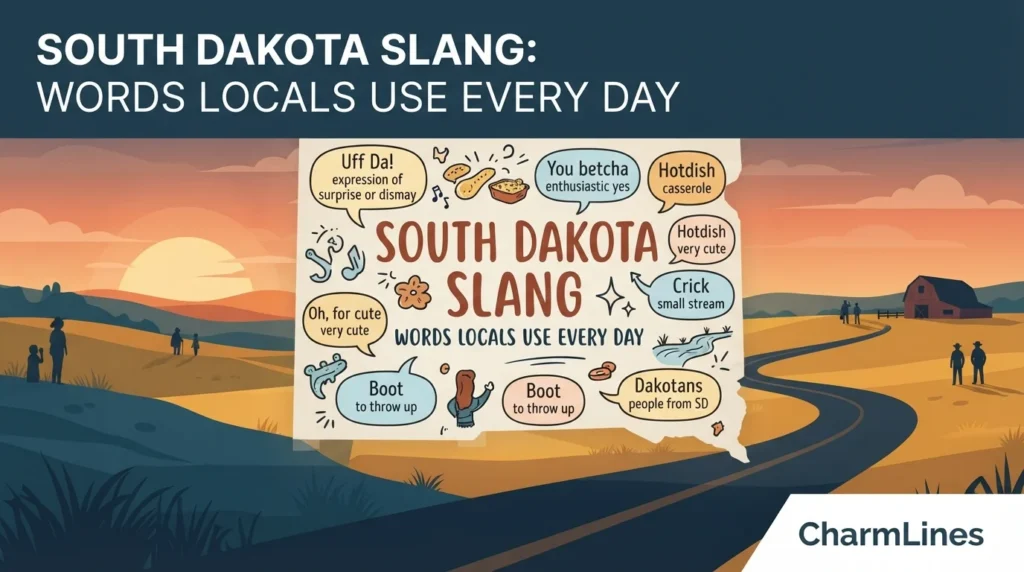
South Dakota slang gives everyday conversation a distinct local flavor. Some expressions come from Midwestern speech, while others are strongly associated with the Mount Rushmore State. From saying something is “pert near” finished to describing something as “cattywampus,” these words can sound unusual to visitors but familiar to locals.
South Dakota slang also includes food terms, regional expressions, place-based language, and newer internet slang. This guide explains the most recognizable South Dakota words and phrases, what they mean, where they come from, and how they are used today.
What Is South Dakota Slang?
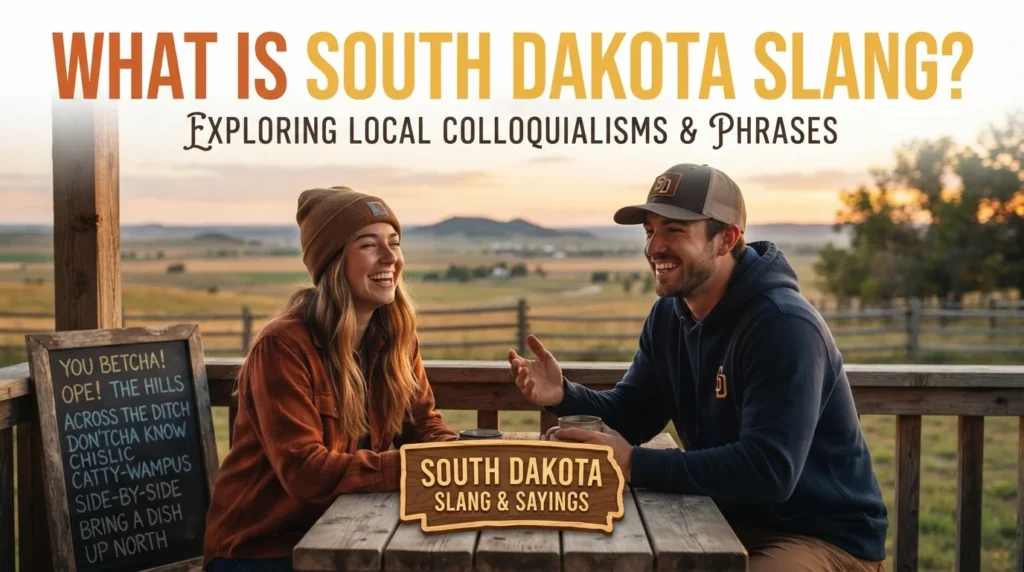
South Dakota slang refers to regional words, expressions, pronunciations, and informal phrases associated with people and communities in South Dakota.
Not every expression is exclusive to the state. Some are shared with neighboring Midwestern states, while others are especially recognizable in South Dakota. Regional vocabulary sources, for example, connect terms such as uffda, hotdish, come with, and you betcha with a broader Upper Midwest speech area that includes South Dakota.
The state’s slang can also vary by location. Terms such as East River and West River have a particularly South Dakota-specific meaning because they refer to the two sides of the Missouri River.
Common South Dakota Slang Words and Phrases
Here are some of the expressions most often associated with South Dakota speech and local culture.
1. Pert Near
Meaning: Almost, nearly, or pretty close.
“Pert near” is one of the expressions repeatedly identified with South Dakota. It can describe distance, degree, or something that is almost finished.
Example:
“The project is pert near finished.”
It can also mean approximately or almost in casual conversation.
2. Cattywampus
Meaning: Crooked, out of place, confused, or not properly aligned.
South Dakota local coverage describes cattywampus as something that is amiss, crooked, or confusing. It can even describe the position of one place relative to another.
Example:
“That picture is hanging cattywampus.”
The word is not exclusive to South Dakota, but it has a strong regional flavor in local usage.
3. Get a Wiggle On
Meaning: Hurry up or move faster.
If someone in South Dakota tells you to “get a wiggle on,” they are telling you that it is time to move. Local South Dakota coverage identifies the expression as a commonly recognized phrase in the state.
Example:
“Get a wiggle on or we’re going to be late.”
4. Taverns
Meaning: A type of loose-meat or Sloppy Joe-style sandwich.
This is one of the more distinctive South Dakota food terms. In parts of South Dakota, a tavern can refer to a messy beef or pork sandwich that other Americans may call a Sloppy Joe. Some South Dakota sources also note regional variation in what the sandwich is called.
Example:
“Let’s stop for taverns before the game.”
5. Hot Beef
Meaning: An open-faced roast beef sandwich served with gravy, commonly alongside mashed potatoes.
“Hot beef” is a South Dakota food expression highlighted in regional travel coverage. The dish is typically an open-faced sandwich with roast beef, mashed potatoes, and gravy.
Example:
“I ordered a hot beef with mashed potatoes.”
6. Truck Topper
Meaning: A canopy or camper shell fitted over a pickup truck bed.
South Dakota terminology sometimes uses truck topper where other regions may say camper shell, truck cap, or canopy.
Example:
“He put a truck topper on his pickup.”
7. Plumb Tuckered Out
Meaning: Extremely tired.
This colorful expression means someone is completely worn out or exhausted. A South Dakota slang roundup pairs it with the playful response “pert’near done run yourself ragged.”
Example:
“After working outside all day, I’m plumb tuckered out.”
8. Wrasslin’
Meaning: Wrestling.
“Wrasslin’” is an informal pronunciation of wrestling and is included among expressions associated with South Dakota speech.
Example:
“We’re going to watch the wrasslin’ tonight.”
9. Pecker Pole
Meaning: A small tree or sapling.
Local South Dakota coverage specifically notes pecker pole as a regional term for a small tree or sapling.
Example:
“We found a pecker pole near the edge of the woods.”
10. Crick
Meaning: Creek or small stream.
In South Dakota usage, crick can refer to a small, slow-moving body of water. This is a regional pronunciation and vocabulary form rather than a uniquely invented South Dakota word.
Example:
“There’s a crick behind the property.”
East River and West River
One of the most important pieces of South Dakota local vocabulary is East River and West River.
These terms refer to the two broad regions divided by the Missouri River. East River means the area east of the Missouri, while West River refers to the area west of it. The terminology is used in everyday regional identity, geography, and conversation.
The terms can also carry cultural meaning. South Dakota sources describe a friendly rivalry between the two sides, with phrases such as “West River, Best River” appearing in local discussion.
Example:
“Are you East River or West River?”
For someone unfamiliar with South Dakota, the question might sound like a simple geographic question. For locals, it can identify where someone lives and sometimes signal regional identity.
You Betcha and Uffda
Some South Dakota expressions are better understood as part of the wider Upper Midwest rather than exclusively South Dakotan.
You Betcha
Meaning: Absolutely, definitely, or you can count on it.
Regional-language references connect you betcha with the Upper Midwest, including South Dakota.
Example:
“Are you coming with us?”
“You betcha.”
Uffda
Meaning: An exclamation expressing surprise, exhaustion, frustration, sympathy, or mild dismay.
Uffda has Scandinavian, particularly Norwegian-American, associations and appears in regional speech across parts of the Upper Midwest. It is not unique to South Dakota.
Example:
“Uffda, that was a long day.”
Because South Dakota has historical Scandinavian and German immigrant influences alongside Indigenous and other linguistic traditions, its regional vocabulary reflects more than one cultural source.
Other South Dakota Words You May Hear
South Dakota speech includes many expressions that are better described as regional vocabulary than strict slang.
Some examples include:
- Hotdish: A casserole-style dish, a term associated broadly with the Upper Midwest.
- Come with: An informal regional construction meaning to come along with someone.
- Supper: A term traditionally used for the evening meal in parts of the region.
- Dinner: Can have a broader or different meal-time meaning depending on the speaker and local context.
- Scotcheroos: A familiar regional dessert bar made with ingredients including chocolate, butterscotch, peanut butter, and crispy rice cereal.
These examples show why “slang” can be a broad category. Some words are informal pronunciations, some are regional vocabulary, and others are names for foods or cultural concepts.
Why Does South Dakota Have Its Own Slang?
South Dakota’s language reflects its geographic position and history.
The state sits within the broader Upper Midwest and Great Plains, so its speech shares vocabulary with nearby states such as Minnesota, North Dakota, Iowa, and Nebraska. At the same time, South Dakota has distinctive regional identities, particularly between East River and West River.
Immigration has also influenced the state’s linguistic history. German and Scandinavian communities contributed words and expressions to the regional vocabulary, while Dakota, Lakota, and Nakota represent Indigenous languages with their own distinct linguistic traditions. South Dakota officially recognizes the language of the Great Sioux Nation, including Dakota, Lakota, and Nakota, as its Indigenous language.
It is therefore more accurate to think of South Dakota slang as part of a broader regional language landscape rather than as a completely separate dialect.
Is South Dakota Slang Different in East River and West River?
There can be differences in vocabulary, identity, and local expressions, but the distinction should not be treated as two completely separate dialects.
East River generally refers to communities east of the Missouri River, including Sioux Falls. West River covers communities west of the river, including Rapid City and the Black Hills.
The terms themselves are among the clearest examples of language that has a specifically South Dakota meaning.
Local sources also describe the East River and West River distinction as a cultural rivalry, sometimes expressed humorously through phrases such as “West River, Best River.”
South Dakota Slang on Instagram
On Instagram, South Dakota slang can appear in captions, comments, travel posts, local humor, and community content.
Expressions such as East River, West River, pert near, and local food terminology can provide regional context in a caption.
For example:
“Pert near ready for the weekend.”
A travel or local-food post might also use terms such as tavern or hot beef when discussing South Dakota food.
There is no evidence that Instagram gives these regional terms a completely separate dictionary meaning. Their interpretation generally comes from the surrounding caption or conversation.
South Dakota Slang on TikTok
TikTok combines local expressions with rapidly changing national internet slang.
A South Dakota creator might use traditional regional language in a video while also using broader TikTok expressions. Current search data reported in 2025, for example, identified “6-7” as one of the highly searched slang expressions in South Dakota. That expression is internet brainrot slang associated with the song “Doot Doot (6 7)” by Skrilla, rather than a traditional South Dakota expression.
This distinction matters: a slang term being popular among South Dakota users does not automatically make it South Dakota slang.
South Dakota Slang on Snapchat
On Snapchat, local expressions are usually used in casual messages, captions, Stories, and conversations between friends.
A phrase such as “get a wiggle on” could be used jokingly when telling a friend to hurry, while “pert near” could appear naturally in an informal message.
The meaning generally remains the same as it does in spoken conversation.
South Dakota Slang on Discord
Discord usage depends heavily on the community.
A South Dakota gaming group may use local expressions alongside gaming abbreviations and national internet slang. For example, someone might use East River or West River when discussing where they live, while the rest of the conversation uses standard gaming terminology.
There is no established evidence that Discord assigns special platform-specific meanings to traditional South Dakota expressions.
South Dakota Slang on Reddit
Reddit provides some of the clearest examples of people discussing South Dakota’s local language and place-based terminology.
South Dakota and Rapid City communities have discussions about local phrases, pronunciation, place nicknames, and expressions unfamiliar to newcomers. Recent community discussions have mentioned constructions such as “I have to go to the store yet” and the habit of ending statements with “you know?” as examples of local speech patterns.
Reddit should be treated as anecdotal evidence rather than a formal dictionary, because individual users may disagree about which expressions are genuinely widespread.
South Dakota Slang on Facebook
Facebook is particularly useful for local-community language because neighborhood groups, hometown pages, alumni groups, and South Dakota communities often preserve regional expressions.
Words such as tavern, pert near, East River, and West River can appear naturally in discussions about food, weather, travel, sports, and local events.
The meaning usually comes from the normal regional use rather than from Facebook itself.
South Dakota Slang on X, Formerly Twitter
On X, South Dakota slang can appear in posts about state politics, weather, sports, agriculture, travel, and local culture.
Because X mixes local and national audiences, a regional term may sometimes need context. A South Dakota user writing “West River” may expect local readers to understand the geographic meaning immediately, while someone outside the state may need an explanation.
South Dakota Slang on YouTube
YouTube creators from South Dakota may use regional vocabulary naturally in videos about daily life, food, hunting, farming, travel, sports, or local history.
Comments can also turn regional words into discussion topics. Someone unfamiliar with pert near, taverns, or East River may ask what the expression means, creating an informal explanation in the comment section.
South Dakota Slang in Gaming Communities
Gaming communities generally combine local expressions with worldwide gaming terminology.
A South Dakota gamer could use “get a wiggle on” as a humorous way to tell teammates to hurry, but terms such as GG, AFK, OP, or NPC come from broader gaming culture rather than South Dakota.
This means South Dakota identity can influence the conversation without creating a separate South Dakota gaming dictionary.
Modern Internet Slang in South Dakota
South Dakota residents also search for and use the same internet slang that circulates throughout the United States.
Recent South Dakota search-data coverage identified terms such as FAFO, FWB, WYF, ASL, DW, TS, MB, WYO, TBH, and ISTG among the state’s most searched text abbreviations in 2026.
These should not automatically be classified as South Dakota slang. They are examples of broader internet or text slang that South Dakota users search for.
That distinction is important:
South Dakota regional slang = language associated with local speech and culture.
Internet slang used in South Dakota = nationwide online expressions that South Dakota users also use or search.
Does South Dakota Slang Have One Single Origin?
No. South Dakota’s regional vocabulary developed through several linguistic and cultural influences.
The state has strong connections to the wider Upper Midwest, Great Plains, Scandinavian-American communities, German heritage, and Indigenous languages. Some expressions therefore have origins outside South Dakota but became familiar in the region.
For example, uffda has Scandinavian connections, while you betcha and hotdish are shared across the Upper Midwest.
Meanwhile, East River and West River have a particularly strong connection to South Dakota’s geography and regional identity.
Are South Dakota Slang Words Still Used Today?
Yes, although usage varies by age, location, family, and community.
Some expressions remain common in everyday speech, while others are more strongly associated with older generations or rural communities. Local publications continue to document regional expressions, and South Dakota communities still discuss local vocabulary online.
At the same time, social media exposes South Dakotans to rapidly changing national internet slang. This means traditional regional vocabulary and modern online language can exist side by side.
South Dakota Slang Examples in Conversation
Here are a few natural examples showing how these expressions can work in context:
- “I’m pert near finished with it.”
Meaning: I’m almost finished. - “That sign is hanging cattywampus.”
Meaning: The sign is crooked or out of alignment. - “Get a wiggle on.”
Meaning: Hurry up. - “Uffda, that was a long drive.”
Meaning: An expression of exhaustion or mild dismay. - “Are you East River or West River?”
Meaning: Which side of the Missouri River do you live on? - “Let’s grab some taverns.”
Meaning: Let’s get the local-style loose-meat sandwiches. - “I’m plumb tuckered out.”
Meaning: I’m extremely tired. - “There’s a crick back there.”
Meaning: There’s a creek or small stream back there.
South Dakota Slang vs. General Midwest Slang
South Dakota slang overlaps heavily with neighboring Midwestern vocabulary.
Words such as uffda, hotdish, you betcha, and come with are not exclusive to South Dakota. Regional-language sources place them across multiple Upper Midwestern states.
What makes South Dakota distinctive is the combination of these broader regional terms with local expressions, food vocabulary, geographic terminology, and place-based identity.
East River and West River are particularly useful examples because they have a specific South Dakota geographic meaning tied to the Missouri River.
Summary
South Dakota slang is not a single fixed list of words. It is a mixture of local expressions, regional vocabulary, food terms, pronunciation patterns, and place-based language.
Words and phrases such as pert near, cattywampus, get a wiggle on, taverns, hot beef, truck topper, plumb tuckered out, wrasslin’, East River, and West River help illustrate the state’s distinctive speech.
Some expressions are genuinely regional, while others are shared throughout the Upper Midwest. Modern South Dakotans also use nationwide internet slang, so it is useful to distinguish traditional South Dakota language from online slang that happens to be popular in the state.
Frequently Asked Questions About South Dakota Slang
What is the most common South Dakota slang?
There is no official single “most common” South Dakota slang word. Local sources frequently highlight expressions such as pert near, cattywampus, get a wiggle on, and regional terms such as East River and West River.
What does “pert near” mean in South Dakota?
Pert near means almost, nearly, or pretty close. It can describe distance or something that is nearly completed.
What does cattywampus mean in South Dakota?
Cattywampus means crooked, out of alignment, confused, or out of place. South Dakota local coverage identifies it as a recognizable regional expression.
What does “get a wiggle on” mean?
Get a wiggle on means hurry up or move faster. It is included among South Dakota expressions used to tell someone to get moving.
What does East River mean in South Dakota?
East River refers to the part of South Dakota east of the Missouri River. It is paired with West River, which refers to the area west of the Missouri.
What does West River mean in South Dakota?
West River refers to the South Dakota region west of the Missouri River, including areas such as Rapid City and the Black Hills.
What does “tavern” mean in South Dakota?
In parts of South Dakota, tavern refers to a loose-meat sandwich similar to what many Americans call a Sloppy Joe. The terminology varies within the state.
Is “uffda” South Dakota slang?
Uffda is used in South Dakota, but it is not exclusive to the state. It is associated with Scandinavian-American speech and is found across parts of the Upper Midwest.
Is “you betcha” a South Dakota saying?
You betcha is used in South Dakota, but it is more accurately described as broader Upper Midwest regional speech rather than an expression unique to South Dakota.
Does South Dakota have its own dialect?
South Dakota has recognizable regional speech patterns and vocabulary, but there is no single completely separate “South Dakota dialect.” Its speech reflects broader Upper Midwest and Great Plains influences as well as local and Indigenous linguistic traditions.
What internet slang is popular in South Dakota?
South Dakota users search for many of the same internet and texting expressions used nationally. Recent 2026 search-data coverage highlighted abbreviations such as FAFO, FWB, WYF, ASL, DW, TS, MB, WYO, TBH, and ISTG. These are general internet abbreviations, not necessarily South Dakota-specific slang.
Is South Dakota slang still used today?
Yes. Current local publications and online South Dakota communities continue to document regional words, expressions, pronunciations, and place-based language. At the same time, social media is bringing nationwide internet slang into everyday communication.

Emma Carter is an experienced Editor-in-Chief with more than 15 years of experience leading digital publishing teams and developing high quality editorial content across multiple industries. She specializes in editorial strategy, content governance, SEO publishing, and audience engagement. Throughout her career, Emma has worked with writers, editors, researchers, and digital marketing professionals to produce trustworthy, well researched, and reader focused content.