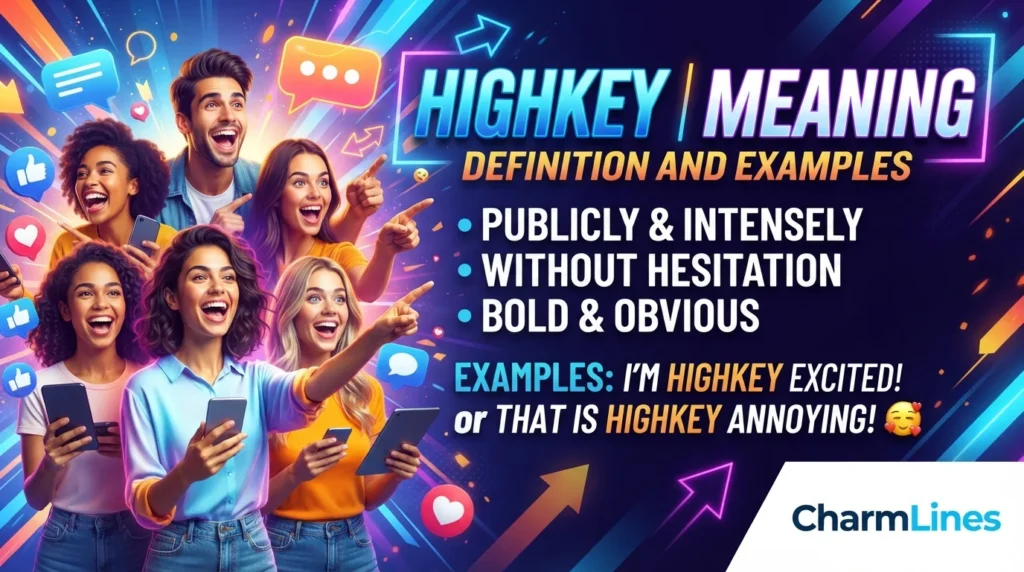
If you’ve spent time on TikTok, X (formerly Twitter), Instagram, Snapchat, or in text messages, you’ve probably seen someone say, “I highkey love this,” or “I’m highkey excited.” The slang term HIGHKEY is a popular internet expression used to emphasize strong feelings, opinions, or honesty. It is essentially the opposite of lowkey, which suggests something is subtle, understated, or slightly true. HIGHKEY has become a staple of Gen Z and online conversations because it lets people express themselves in a casual yet emphatic way.
What Does HIGHKEY Mean?
In modern internet slang, HIGHKEY means:
- Really
- Very
- Definitely
- Honestly
- Openly
- Obviously
It adds emphasis to a statement and signals that the speaker is not trying to hide or downplay their feelings.
For example:
- “I highkey want pizza tonight.”
- “She’s highkey the funniest person I know.”
- “I’m highkey nervous about tomorrow.”
In each example, HIGHKEY simply strengthens the emotion or opinion being expressed.
Search Intent for “HIGHKEY Slang Meaning”
Primary Intent: Informational
People searching for this keyword usually want to:
- Understand what HIGHKEY means in texting and social media.
- Learn how to use HIGHKEY correctly.
- See examples in conversations.
- Discover where the slang originated.
- Understand the difference between HIGHKEY and LOWKEY.
HIGHKEY vs. LOWKEY
These two expressions are opposites in modern slang.
| HIGHKEY | LOWKEY |
| Really | Somewhat |
| Very | Kind of |
| Definitely | Secretly |
| Openly | Quietly |
| Obviously | Subtly |
Examples:
- “I highkey love this movie.” (I really love it.)
- “I lowkey love this movie.” (I kind of love it or secretly love it.)
Sometimes both words appear together for humorous effect:
- “I’m lowkey highkey stressed.”
This means someone is trying to act calm while actually feeling very stressed.
How HIGHKEY Is Used Across Different Platforms
TikTok
Creators often use HIGHKEY in captions to emphasize excitement, opinions, or reactions.
Examples:
- “Highkey obsessed.”
- “Highkey my favorite trend.”
People commonly use HIGHKEY in captions and comments.
Examples:
- “Highkey the best vacation ever.”
- “I’m highkey proud of this.”
X (Twitter)
Because posts are short, HIGHKEY helps add emphasis quickly.
Examples:
- “I highkey need a vacation.”
- “This album is highkey amazing.”
Snapchat
Friends frequently use HIGHKEY in casual chats.
Examples:
- “I’m highkey bored.”
- “Highkey miss hanging out.”
Text Messages
The term is widely used in personal conversations.
Examples:
- “I highkey forgot about the meeting.”
- “I’m highkey excited for the weekend.”
Across platforms, the meaning stays consistent: it expresses a strong, open feeling or opinion.
Origin of HIGHKEY
HIGHKEY developed as the opposite of LOWKEY, which had already become popular in informal English and African American English before spreading through hip-hop culture and social media. While “high-key” originally referred to a bright lighting style in photography, internet users repurposed it to express openness, intensity, and strong emphasis. By the mid-2010s, HIGHKEY was widely used on platforms like Twitter and later exploded on TikTok, Instagram, and other social media sites.
How to Use HIGHKEY Correctly
HIGHKEY usually appears before:
Verbs
- I highkey miss summer.
- We highkey need coffee.
Adjectives
- That’s highkey funny.
- She’s highkey talented.
Entire Statements
- Highkey, I didn’t expect that.
- Highkey, this is the best restaurant in town.
It works naturally in informal conversations but is generally avoided in professional writing.
Common HIGHKEY Examples
Here are some everyday examples:
- “I’m highkey hungry.”
- “This game is highkey addictive.”
- “You’re highkey right.”
- “She’s highkey my favorite teacher.”
- “That movie was highkey emotional.”
- “I’m highkey excited for vacation.”
- “This weather is highkey perfect.”
- “He’s highkey the nicest person here.”
- “We highkey need a break.”
- “I highkey can’t wait.”
When Should You Use HIGHKEY?
HIGHKEY works best in:
- Text messages
- Social media captions
- Online comments
- Casual conversations
- Memes
- Group chats
Avoid using it in:
- Business emails
- Academic papers
- Professional reports
- Formal presentations
Similar Slang Words
If you understand HIGHKEY, you’ll also recognize these internet expressions:
- Lowkey
- Literally
- Honestly
- Fr
- No cap
- Deadass
- For real
These all help speakers emphasize feelings, opinions, or sincerity, though each has its own nuance.
Is HIGHKEY Still Popular?
Yes. HIGHKEY remains widely recognized in Gen Z and younger Millennial online communities. Although slang changes rapidly, HIGHKEY continues to appear frequently in social media posts, comments, memes, and everyday texting because it is easy to understand and pairs naturally with LOWKEY.
Summary
HIGHKEY is an internet slang term that means really, very, definitely, openly, or honestly. It emphasizes strong feelings, opinions, or statements and is commonly used in texts, social media posts, and casual conversations. As the opposite of LOWKEY, it helps speakers express themselves more directly and confidently. While it originated from modern online slang, HIGHKEY has become a widely recognized part of everyday digital communication.
FAQs
What does HIGHKEY mean in slang?
HIGHKEY means really, very, definitely, or openly. It is used to emphasize strong emotions or opinions.
Is HIGHKEY the opposite of LOWKEY?
Yes. LOWKEY usually means subtly, somewhat, or secretly, while HIGHKEY expresses something openly or intensely.
Is HIGHKEY used in texting?
Yes. HIGHKEY is very common in text messages, group chats, and direct messages.
Where is HIGHKEY most commonly used?
It is popular on TikTok, Instagram, X, Snapchat, Discord, and in everyday texting.
Is HIGHKEY formal English?
No. HIGHKEY is informal internet slang and is best suited for casual communication.
Can HIGHKEY describe both positive and negative feelings?
Yes. You can say:
- “I’m highkey excited.”
- “I’m highkey tired.”
- “That’s highkey annoying.”

Sophia Reed is an accomplished Fact-Checking Editor with more than 11 years of experience ensuring the accuracy, credibility, and integrity of digital content. She specializes in verifying facts, reviewing sources, assessing editorial reliability, and maintaining high publishing standards across a wide range of online publications.